
Bermuda Wildlife Conservation
Our work in Bermuda runs through the Atlantic Conservation Partnership, a nonprofit headquartered in Flatts, Bermuda that supports collaborative research and education across the shared marine environments of the United States, Bermuda, and the Caribbean.
 Bermuda, North Atlantic
 - Focus
- Sea turtles Cahow recovery Humpback whale research AI-assisted population analysis Reef and dive-site protection
Species at the center of the work
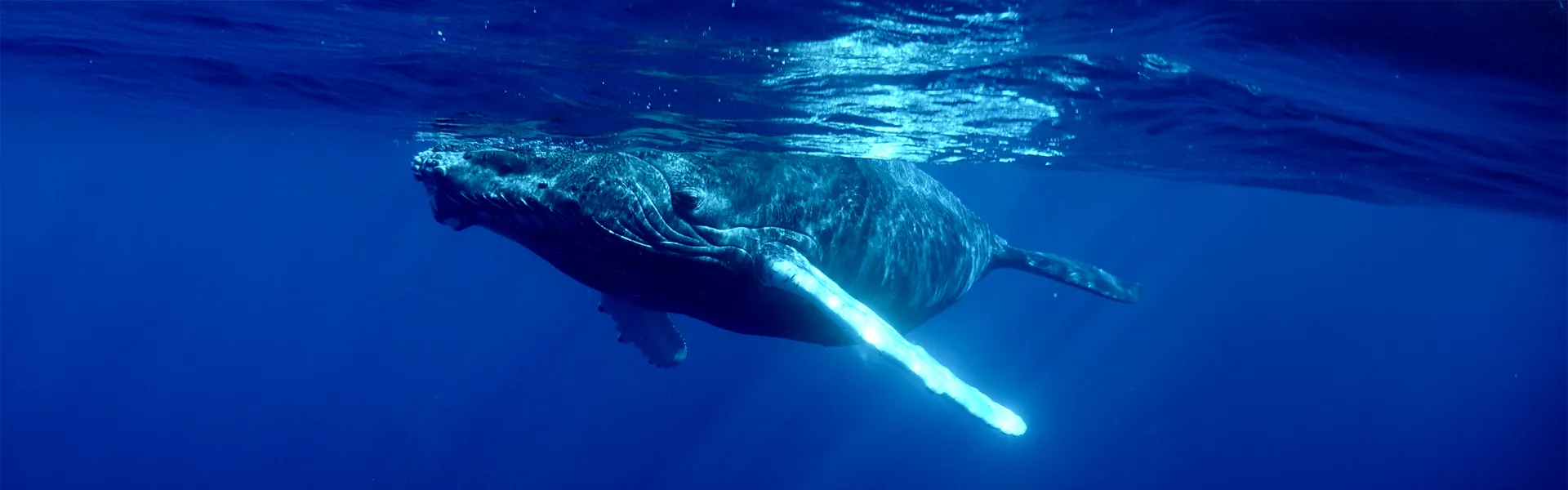
The Bermuda Turtle Project tracks and studies the green sea turtles that use Bermuda's waters as a developmental habitat. The Cahow Recovery Project supports one of the most remarkable bird conservation stories in the Atlantic: the cahow, once thought extinct for three centuries, is now nesting again on Bermuda's outer islets. The Humpback Whale Project follows the migration of North Atlantic humpbacks as they pass Bermuda each spring.
Additional programs include shark research and the protection of vulnerable dive sites whose reef communities draw scientists and visitors alike.
Bringing AI to humpback research
In 2024, the foundation's CEO, Dr. Kim Hammond, partnered with the Atlantic Conservation Partnership, the Bermuda Zoological Society, and Andrew Stevenson of Whales Bermuda to launch a new initiative: bringing artificial intelligence to bear on the humpback whale datasets the Bermuda research community has built over the past two decades.
Since founding Whales Bermuda in 2006, Stevenson has identified more than 2,000 individual whales by their distinctive tail markings, using underwater and aerial video alongside hydrophone recordings. The new project aims to make that archive useable at scale, applying AI to questions about population health, migration dynamics, and whether environmental pressures like cruise-ship traffic and ocean noise are affecting the whales that pass Bermuda each spring.
The fieldwork is centered on Sally Tuckers fishing ground, off Bermuda's South Shore. As Dr. Hammond described it to the Royal Gazette, the goal is to assemble existing data "in a useable form but also do it at speeds that we can't do it, it will do it instantly."
A regional partnership
The Atlantic Conservation Partnership is built on the recognition that the species, currents, and pressures that shape Bermuda's environment also shape the wider Atlantic basin. The partnership exists to make the research and the protection it enables collaborative across the United States, Bermuda, and the Caribbean.
Training the next generation
Field science depends on the people who will run it next. The partnership funds the James W. Babcock Internship Program and the International Course on Sea Turtle Biology and Conservation, training young scientists in the practical skills that field research demands.
Read about Atlantic Conservation Partnership directly from the team running the work.
Help fund the work on this page.
Every donation goes directly to active programs led by the partners we support.
Donate